Artificial Peptide Enzymes for Living Cells
Artificial metallopeptide catalysts represent a powerful approach to performing bioorthogonal chemistry within the complex environment of living cells. While transition metals like palladium are highly effective in organic synthesis, their activity is often limited in vivo due to rapid deactivation by cellular components. To overcome this, synthetic catalysts are created by grafting metal complexes into engineered peptide scaffolds. These scaffolds act as a protective shell that preserves the metal’s catalytic power, enabling transformations like depropargylation directly inside human HeLa cells.
We are currently focused on integrating these catalytic platforms into targeted peptide systems to achieve the selective bioorthogonal activation of prodrugs. By engineering peptides that can recognize specific cellular markers, we aim to localize chemical transformations within diseased tissues. This strategy seeks to maximize the local concentration of active therapeutics while reducing systemic side effects, bridging the gap between molecular design and precision medicine.

Our group reported the de novo engineering of palladium-miniproteins, which are artificial metalloproteins designed to function as robust intracellular catalysts. We used the triple-stranded β-sheet of a model WW domain (based on the 1E0M prototype reported by Dr. Maria Macías) as a scaffold, grafting Pd(II) complexes onto its surface. A thorough NMR and computational study revealed that the concave molecular architecture of the β-sheet shields the metal center from rapid deactivation by cellular quenchers. This structural protection allowed the synthetic enzyme to remain active longer than earlier α-helical designs.
We demonstrated that these palladominiproteins efficiently catalyze depropargylation reactions in HeLa and HepG2 cells with a turnover number of approximately 9. These results showcase the potential of compact β-sheet domains as cell-compatible platforms for performing transition-metal chemistry in vivo..
Engineering Palladominiproteins

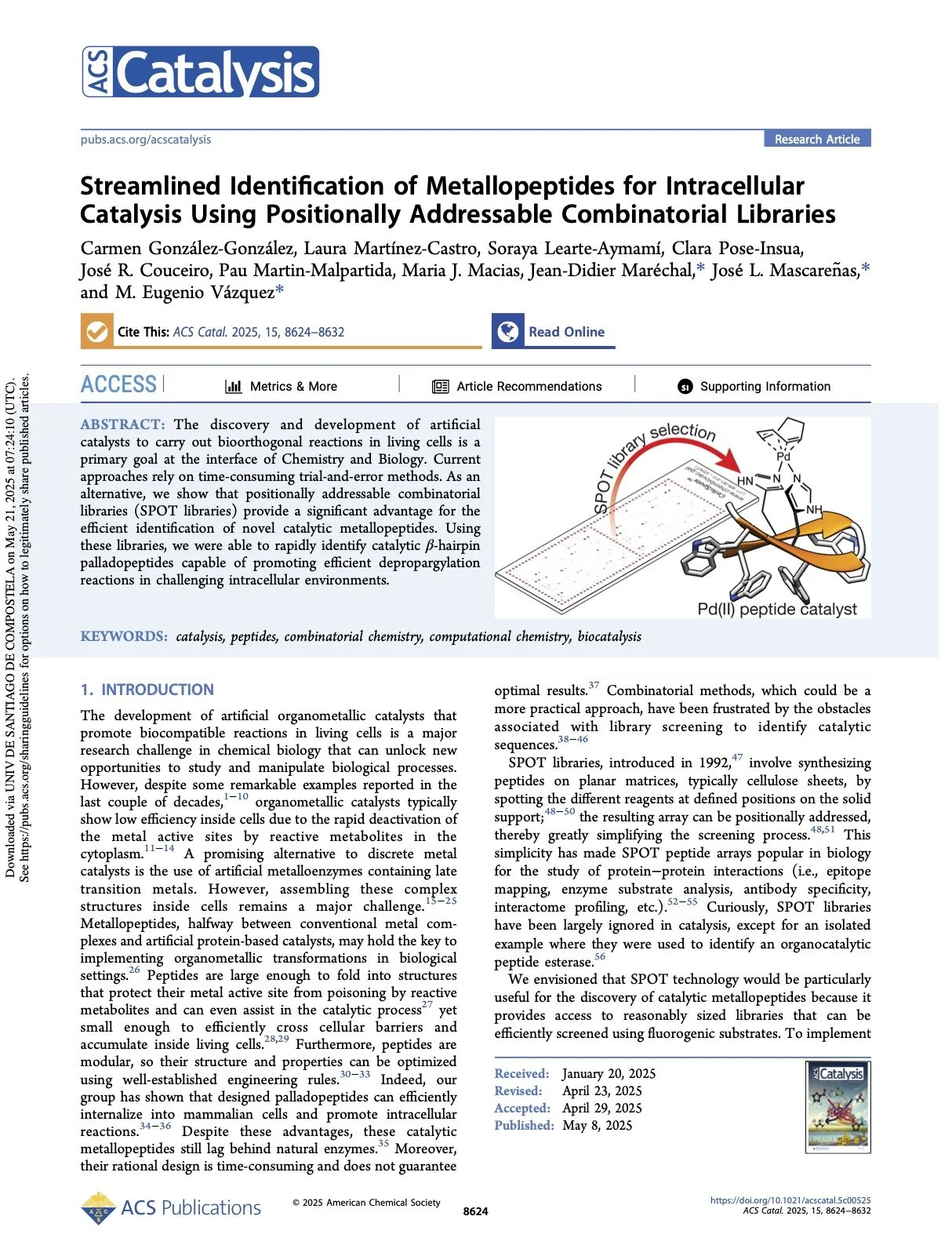
To move beyond traditional trial-and-error discovery methods, we introduced a high-throughput strategy using positionally addressable combinatorial libraries (SPOT libraries).
We designed a library based on the tryptophan zipper (trpzip) β-hairpin scaffold, varying the positions of metal-chelating residues and the surrounding amino acid environment. Using the CelluSPOT technique to miniaturize the assay, we screened 264 peptides with fluorogenic probes to identify sequences with superior catalytic activity. This approach led to the rapid identification of a short sequence (AWHWRGNVWHWT), a stable palladopeptide that exhibits high affinity for Pd(II) and maintains its fold upon coordination. This catalyst promotes efficient depropargylation in challenging environments, including living mammalian cells, where it operates with a turnover number of about five. This platform significantly streamlines the development of robust, genetically encodable bioorthogonal catalysts.
Streamlined Catalyst Discovery
Controlling KRAS Signaling with designed metallopeptides
We also explored the applications of metal coordination beyond intracellular catalysis, for the conformational control of peptide bidners. We developed a palladium-responsive peptide designed to modulate the signaling pathways of oncogenic KRAS, a key target in cancer research due to its role in regulating cell proliferation.
By deriving a sequence from the α-H helix of the SOS1 cofactor, we engineered a bis-histidine coordination site at positions Tyr933 and Ile937. Using NMR spectroscopy and Gaussian accelerated molecular dynamics (GaMD), we demonstrated that Pd(II) coordination exerts a nucleating effect, facilitating the transition of the peptide into its bioactive α-helical conformation. This system functions as a switchable binder: the interaction with KRAS is triggered by the addition of Pd(II) and can be reversed by an external metal chelator. Experiments in lung carcinoma A549 cells confirmed that the metallopeptide internalizes efficiently and successfully inhibits the MAPK kinase cascade, marking the first demonstration of a switchable, metal-regulated KRAS inhibitor in living cells.