Conductive peptide materials
The field of electronic materials has historically relied on the hard, unyielding world of minerals and metals. However, a new chapter is emerging at the intersection of biology and physics, where we view peptides as a versatile platform for the next generation of electronics. Unlike the rigid, non-degradable silicon or copper that powers modern technology, peptide-based materials are sustainable, biocompatible, and structurally programmable. Inspired by the long-range electron transfer found in natural systems—such as the protein nanowires that certain bacteria use to communicate and breathe—we design synthetic fibers that bridge the gap between biological complexity and digital technology. These "living wires" offer a path toward soft electronics that are fundamentally integrated with life.

Self-assembled coiled-coil conductive nanowires
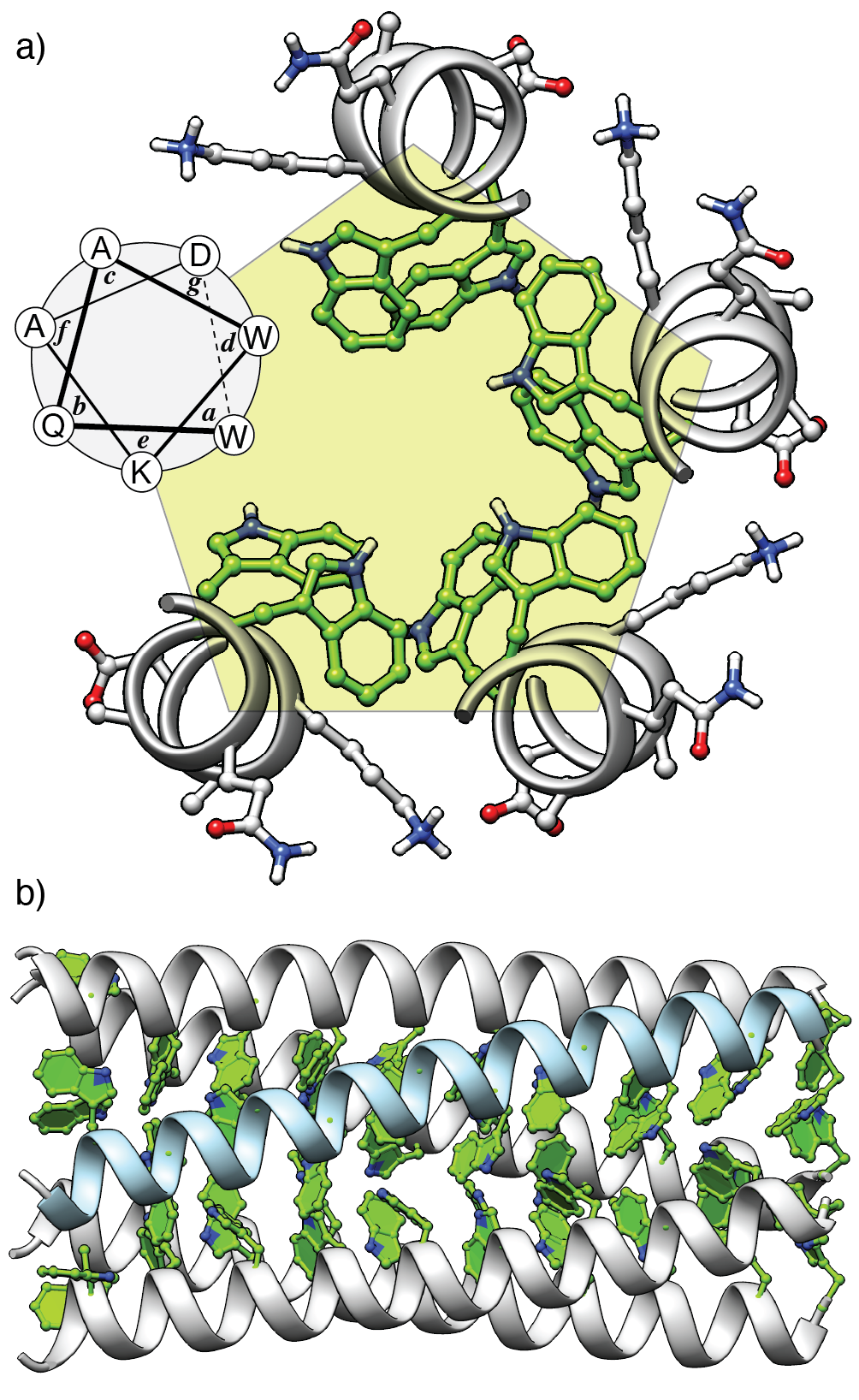
Our recent work on designed tryptophan zipper nanowires provides a direct blueprint for this molecular-level control. We used a computational workflow, combining Rosetta simulations with AlphaFold3 and deep-learning algorithms, to design a 35-residue peptide, (WQAWKAD)5, that spontaneously assembles into robust pentameric bundles. These bundles associate head-to-tail into elongated fibers that can reach several microns in length, driven by precisely engineered electrostatic complementarity. At the heart of these fibers lies a hydrophobic core of closely packed tryptophan side chains; this organization creates a continuous network of π-stacked indole rings that allow electrons to hop along the fiber axis.
Our measurements confirmed that these materials exhibit intrinsic, temperature-activated electronic conductivity that remains stable across a wide range of environmental conditions. This study represents a significant step toward engineering a new class of conductive soft materials that combine the electronic capabilities of a semiconductor with the modularity and sustainability of biological systems.