Non canonical DNA recognition
On August 25, 1942, Dr. Gustaf Lindskog administered to a patient with non-Hodgkin’s lymphoma the first intravenous chemotherapy for cancer: an experimental treatment with a DNA alkylating agent. Today, almost 80 years later and even after the spectacular developments in targeted therapies, cytotoxic agents that aim at the DNA, including cross-linking agents, are still essential weapons in the chemotherapeutic arsenal. Beyond the canonical antiparallel double-stranded B‑DNA conformation, non-canonical DNA structures, such as G‑quadruplexes, or three‑way junctions (3WJs), have emerged as key players in cancer, and as promising alternative DNA targets that could afford new agents with better therapeutic properties.
Together with Miguel Vázquez @ CiQUS, we have developed a number of systems capable of selectively binding to some of these non-canonical DNA structures that show promising antitumoral properties

Peptide helicates (with Miguel Vázquez)
Metal ions offer vast opportunities for the structural control at the molecular scale; exploiting their different coordinative properties, researchers can create complex assemblies of great beauty and unique properties, on par with the extraordinary structural and functional complexity displayed by designed peptides. Bridging the architectural potential of coordination chemistry with the structural predictability of peptide scaffolds would allow greater complexity in (supra)molecular designs by combining well-established peptide engineering concepts and tools with the supramolecular organization mediated by metal ions. Furthermore, the use of peptide ligands circumvents inefficient and labor-intensive multistep organic synthesis procedures typically associated with classic organic ligands, and simplifies the access to multiple variants required for optimization of the desired properties.
Helicates are discrete metal complexes in which one or more organic ligands coil around—and coordinate—two or more metal ions. Helicates are inherently chiral species that can appear as two enantiomers, according to the orientation in which the ligands twist around the helical axis defined by the metal centers. Besides their intrinsic interest in supramolecular chemistry, helicates have shown exciting properties as antifreeze agents, or inhibitors of amyloid aggregation, as well as unique G‑quadruplex and three-way DNA binding properties that result in promising antimicrobial and antitumoral activities.
selective three-way DNA junction binding
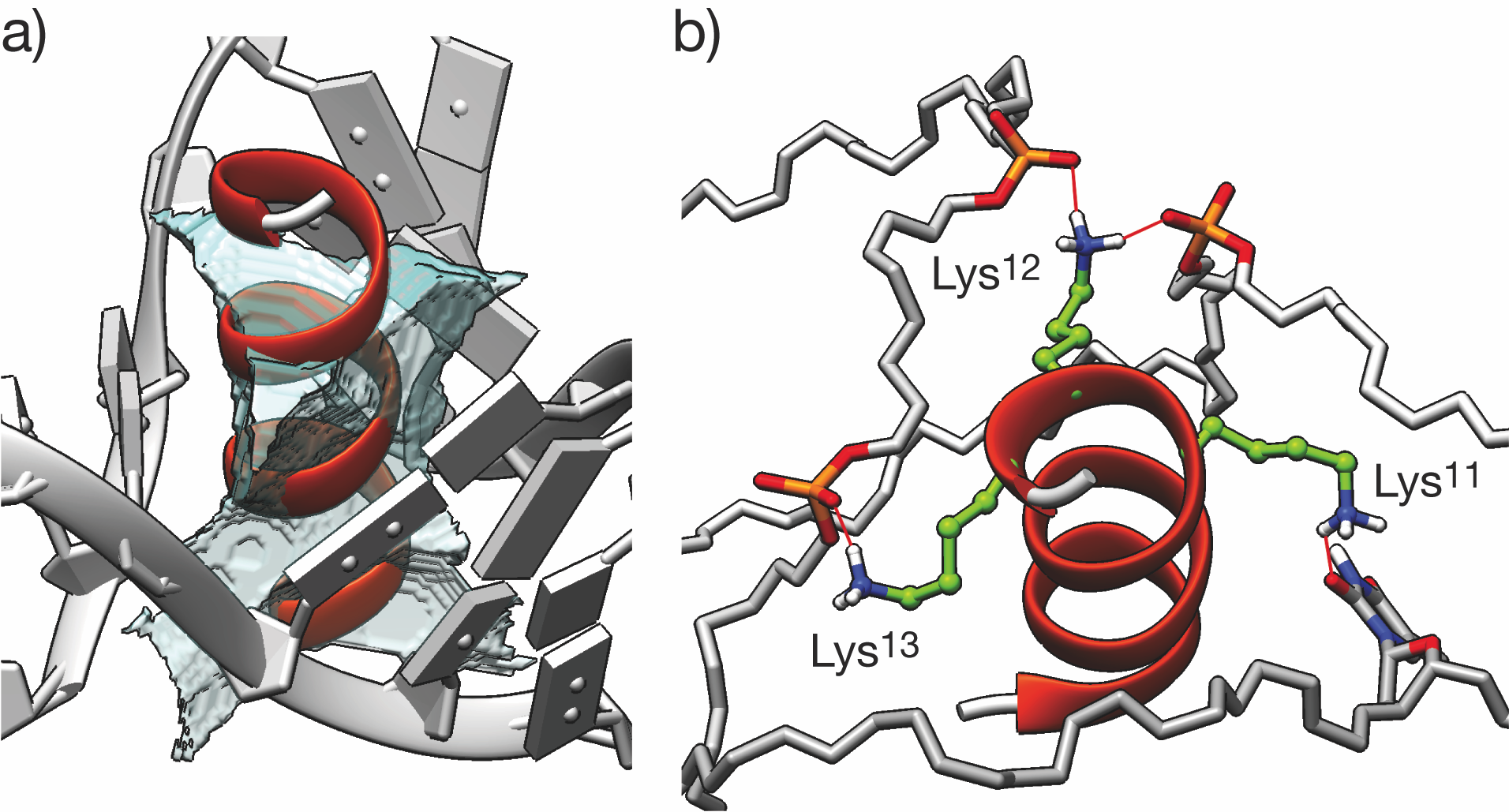
A turning point in the development of therapeutic agents targeting non-canonical DNA structures, in particular 3WJs, was the discovery in 2006 by the group of Prof. M. J. Hannon that metal helicates bind to the branching point of 3WJs. This was unexpected because researchers assumed that these helicates would interact with the major groove of DNA because their size is similar to that of the DNA-binding α-helices of natural transcription factors. So we asked ourselves, reversing Prof. Hannon's initial chemical intuition, if helicates resemble α-helices, could then an α-helical peptide bind with good affinity to the central cavity of a 3WJ, provided that its size is similar to that of a metal helicate? Interestingly, natural resolvases follow a similar strategy to bind Holliday Junctions (HJ) by inserting a pair of α-helices into the large central cavity of the junction, which suggested that this could also be a viable approach for targeting 3WJs. As we envisioned, here we show that rationally designed alanine-rich α-helical peptides selectively target the central cavity of DNA three-way junctions with nanomolar affinity and good selectivity against canonical double-stranded DNA. Furthermore, we demonstrate that these peptides inhibit 3WJ enzymatic processing by T7 Endonuclease I and show selective cytotoxicity in rad52Δ DNA repair-deficient yeast strains. These results establish α-helical peptides as a viable scaffold for targeting non-canonical DNA structures associated with microsatellite instability. (work in progress!!).